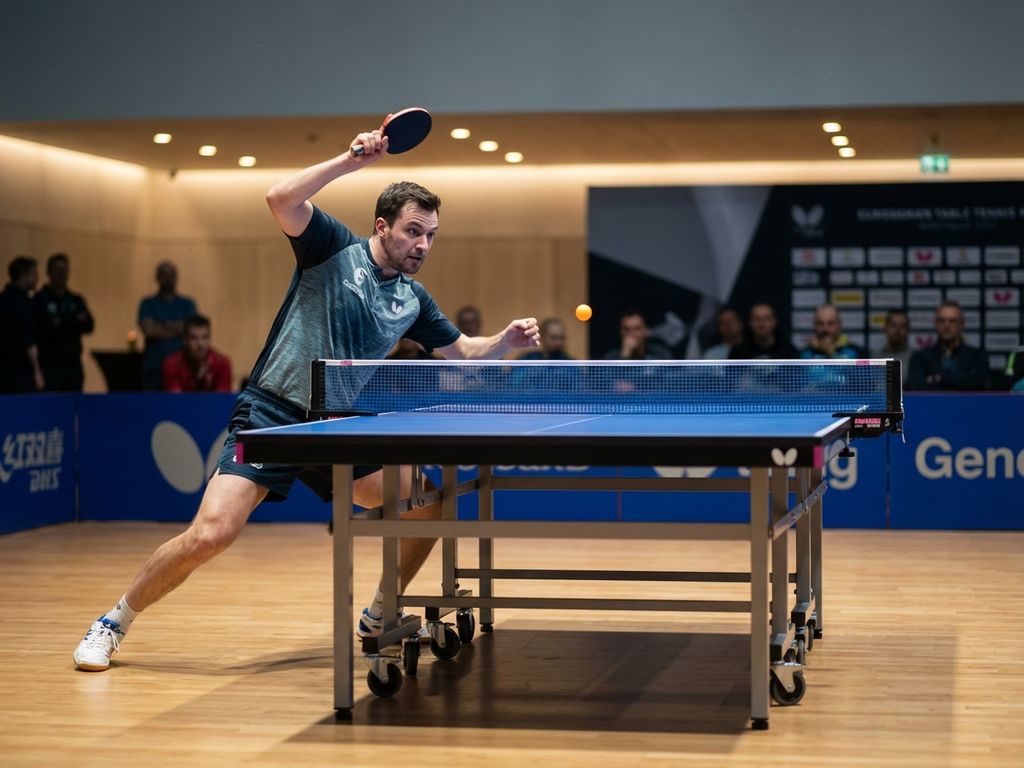
Choose ping pong for tabletop rallies, including a social-venue outing, and pickleball for court-based singles or doubles. Before assuming one sport is universally easier, compare their playing space, serve mechanics, bounce sequences, volley restrictions, and scoring formats.
Both sports use solid paddles and plastic balls, yet they operate on completely different spatial scales and tactical rules. Examining official governing standards and physical requirements helps clarify which sport fits your upcoming session.
Choose Tabletop Rallies or Court Play
The core difference between ping pong and pickleball is the physical playing boundary, separating a raised nine-foot tabletop from a forty-four-foot ground court.
At SPIN, we host table tennis gatherings across our social clubs. Table tennis is played across a compact tabletop surface, while pickleball is played across a 20-foot by 44-foot court.
During a pickleball rally, players must follow the two-bounce serving sequence before volleying, and while volleys are prohibited in the seven-foot non-volley zone, the kitchen can be entered at any other time.
In traditional pickleball doubles, teams follow a side-out rotation where both partners serve except in the first service sequence of each game, so groups should set game scoring rules in advance.
Rather than assuming one sport is universally easier, beginners should decide conditionally based on whether they want tabletop rallies or court play. Table tennis provides tabletop play that fits an indoor social gathering. A reader wanting court-based play across a full boundary should choose pickleball.
Ping Pong vs Pickleball Side by Side
Comparing official equipment and court specifications side by side clarifies how physical space and ball dynamics shape each game.
The International Table Tennis Federation (ITTF) 2026 statutes govern competitive table tennis worldwide. Law 2.1.1 specifies a table 2.74 meters long and 1.525 meters wide, elevated 76 centimeters off the floor. Under Law 2.3, the ball must be a 40-millimeter plastic sphere weighing exactly 2.7 grams. Table tennis paddles consist of a flat, rigid blade that is at least 85 percent natural wood by thickness, faced with pimpled or sandwich rubber sheets under Laws 2.4.2 and 2.4.3.
In contrast, USA Pickleball defines court specifications measuring 20 feet wide by 44 feet long for both singles and doubles formats. The net measures 36 inches high at the sidelines and droops to 34 inches at the center. Pickleball balls are perforated plastic spheres manufactured with 26 to 40 circular holes. USA Pickleball requires paddles made of rigid, non-compressible material.
| Factor | Ping Pong (Table Tennis) | Pickleball |
|---|---|---|
| Playing Surface | 2.74m by 1.525m table raised 76cm off the floor | 20ft by 44ft court |
| Net Dimensions | 15.25cm high across the table with 15.25cm side overhang | 36in high at sidelines and 34in high at the center |
| Ball Construction | 40mm matt plastic ball weighing 2.7g | Perforated plastic ball with 26 to 40 circular holes |
| Paddle Specifications | Rigid blade with at least 85% natural wood and rubber sheets | Rigid, non-compressible paddle |
| Volley Zone Restriction | No volleys allowed anywhere over the table | 7ft non-volley zone (kitchen) on both sides of net |
| Standard Game Target | Normally 11 points, win by 2; matches are the best of an odd number of games | Normally 11 points, win by 2; tournament games may play to 15 or 21, and rally scoring is also recognized |
Ping Pong vs Pickleball Rules for a First Session
Service mechanics, volley restrictions, and scoring sequences represent the most important rule differences for new players in their first session.
Table tennis service requires an open-palm toss behind the end line. Under ITTF Law 2.6, the ball must rest on a flat, stationary palm before being projected vertically upward at least 16 centimeters without spin. As the ball descends, the server strikes it so it bounces once on the server's court and then once on the receiver's court. Players alternate service every two points under Law 2.13.3, switching to alternating single serves if the score ties at 10-10.
Volleying is strictly illegal in ping pong. ITTF Law 2.5.8 defines obstruction as touching the ball before it bounces while it is over or traveling toward your playing surface. If you strike a table tennis ball out of the air before it lands on your side, you forfeit the point immediately under Law 2.10.1.6. To review complete service toss rules and fault conditions, read our guide to ping pong serving and scoring rules.
Pickleball follows fundamentally different service and volley structures. According to the USA Pickleball rules summary, a standard volley serve must use an upward arm arc with paddle contact below waist level into the diagonal court, whereas an allowed drop serve is exempt from these arc and height restrictions. The game enforces a strict two-bounce rule: the receiving team must let the serve bounce once, and the serving team must let the return bounce once before anyone can hit a volley.
Once those initial two bounces occur, pickleball players can volley balls out of the air, provided they stay behind the non-volley zone line. This seven-foot area on both sides of the net is known as the kitchen. Stepping on the kitchen line or having your forward momentum carry you into the zone while hitting a volley is a fault.
Scoring structures also diverge between the sports. Modern table tennis uses standard rally scoring where the winner of each exchange earns a point, leading to games played to 11 points with a two-point margin. In traditional pickleball, only the serving team scores points, though modern tournament play also incorporates rally scoring formats. In traditional doubles pickleball, both teammates have an opportunity to serve before the serve passes to the opposing side.
Plan a Session for Two, Four or a Larger Group
Both ping pong and pickleball support singles and doubles formats, but handling groups larger than four requires organized player rotations or multiple courts.
Singles matches feature head-to-head play in both sports. In table tennis singles, the serve does not require a diagonal path but must bounce first on the server's side and then on the receiver's side, leading to direct head-to-head rallies. In pickleball singles, players serve diagonally from the right when the score is even and from the left when odd.
Doubles play introduces unique team mechanics. Table tennis doubles enforces a mandatory shot rotation under ITTF Law 2.8.2. The server delivers to the opponent's right half-court, the receiver returns, the server's partner hits the third stroke, and the receiver's partner hits the fourth stroke. Failing to alternate shots in this exact order forfeits the point under Law 2.10.1.12.
Pickleball doubles does not require alternating partner shots. Once the two-bounce rule is satisfied, either partner may return incoming shots.
For groups with five or more participants, neither sport accommodates everyone on a single playing surface at once. Organizers must set up player rotations or tournament brackets across playing spaces. If you are coordinating a department event or social party, exploring SPIN team building options provides structured tournament schedules and dedicated multi-table areas designed for larger group interaction.
Choose the Setting That Matches the Plan
Selecting between ping pong and pickleball often depends on whether your outing calls for an indoor hospitality setting, a dedicated training facility, or an outdoor recreational park.
Table tennis venues range from social ping pong clubs to specialized athletic training centers. At SPIN venues, as published in official SPIN FAQ and team-building sources, guests receive Stiga paddles and stocked ball baskets alongside restaurant catering and cocktail bars. This setting allows groups to combine competitive gaming with drinks and casual dining regardless of outdoor weather.
Pickleball can be played indoors or outdoors on courts measuring 20 feet by 44 feet. USA Pickleball notes slightly different ball designs are used for indoor and outdoor surfaces.
| Session Goal | Ping Pong Recommendation | Pickleball Recommendation |
|---|---|---|
| Casual Social Night Out | Best option at indoor social clubs with food, drinks, and shareable tables | Indoor or outdoor court play |
| Outdoor Athletic Doubles | Tabletop rallies are centered around indoor social venue tables | Best option on dedicated public or private 20ft by 44ft outdoor courts |
| High-Volume Group Rotation | Requires player rotations or multiple tables for parties larger than four | Requires player rotations or multiple courts for parties larger than four |
| Structured Technical Training | Best at dedicated table tennis clubs for structured training | Best at dedicated clubs offering structured court instruction |
Who Should Choose a Different Option
Neither sport suits every group outing, and recognizing specific physical and venue limitations prevents booking the wrong activity.
Groups seeking full-court outdoor doubles should choose a suitable pickleball court. Ping pong takes place around a tabletop rather than a full-sized court.
Players wanting quiet, formal athletic coaching should seek specialized training academies rather than social entertainment clubs. Venues with music, dining, and cocktail bars are designed for lively social gatherings rather than quiet technical drilling.
Age restrictions also dictate venue choices. At SPIN social clubs, venues welcome all ages during the day but transition to a strict 21-and-over policy after 9 PM. Groups organizing family outings with minors in late evening hours should book daytime table reservations or choose public community facilities.
What Would Change the Choice
Venue availability, weather forecasts, equipment access, and group size can easily reverse your initial activity choice.
Inclement weather is the quickest factor to flip a plan. If weather disrupts an outdoor session, choosing an indoor table tennis outing provides a protected playing space. Because pickleball can also be played indoors using designated indoor balls, groups can evaluate indoor court availability alongside indoor table tennis if weather disrupts an outdoor session.
Equipment ownership also influences the decision. Pickleball players using public courts typically need to provide their own rigid paddles and perforated balls unless visiting a facility with equipment rental. For groups without gear, visiting a SPIN location provides Stiga paddles and unlimited balls, removing the equipment barrier according to official SPIN FAQ sources.
Social dynamics provide another boundary. Table tennis at a social club allows groups to gather around tables with food and drinks.
Our Takeaway
Decide based on the playing space and format: choose table tennis for compact tabletop rallies with alternating serves, and choose pickleball for court doubles featuring two-bounce sequences and kitchen play. A reader wanting a full-court outdoor doubles session should choose a suitable pickleball court even if SPIN suits an indoor evening social plan. A reader wanting structured table-tennis training may prefer a training club rather than a nightlife venue. For your ping pong vs pickleball session, check SPIN table availability or USA Pickleball court options.
Frequently Asked Questions
Is pickleball harder than ping pong?
Neither sport is universally harder for beginners; difficulty depends on whether you prefer tabletop rallies or court play. Pickleball requires covering a 20-foot by 44-foot court. Ping pong takes place across a 2.74-meter table using a 2.7-gram ball.
What is the difference between pickleball and ping pong?
The primary difference lies in the playing boundary, equipment construction, and service rules. Ping pong is played on a raised table measuring 2.74 meters long with a 40-millimeter plastic ball and rubber-faced paddles. Pickleball is played on a 20-foot by 44-foot court using a perforated plastic ball and rigid paddles. Furthermore, pickleball permits volleys outside its 7-foot kitchen, while ping pong prohibits all volleys across the table.
Is ping pong the same as table tennis?
Ping pong and table tennis describe the exact same sport under modern international standards. In this comparison, ping pong refers to standard table tennis under ITTF rules, and readers exploring naming history can review the origins of ping pong vs table tennis. Today, the International Table Tennis Federation (ITTF) oversees competitive play under the table tennis name, while casual players and social clubs use both terms interchangeably. To learn more about facility guidelines, review SPIN equipment and family policies before planning an outing.