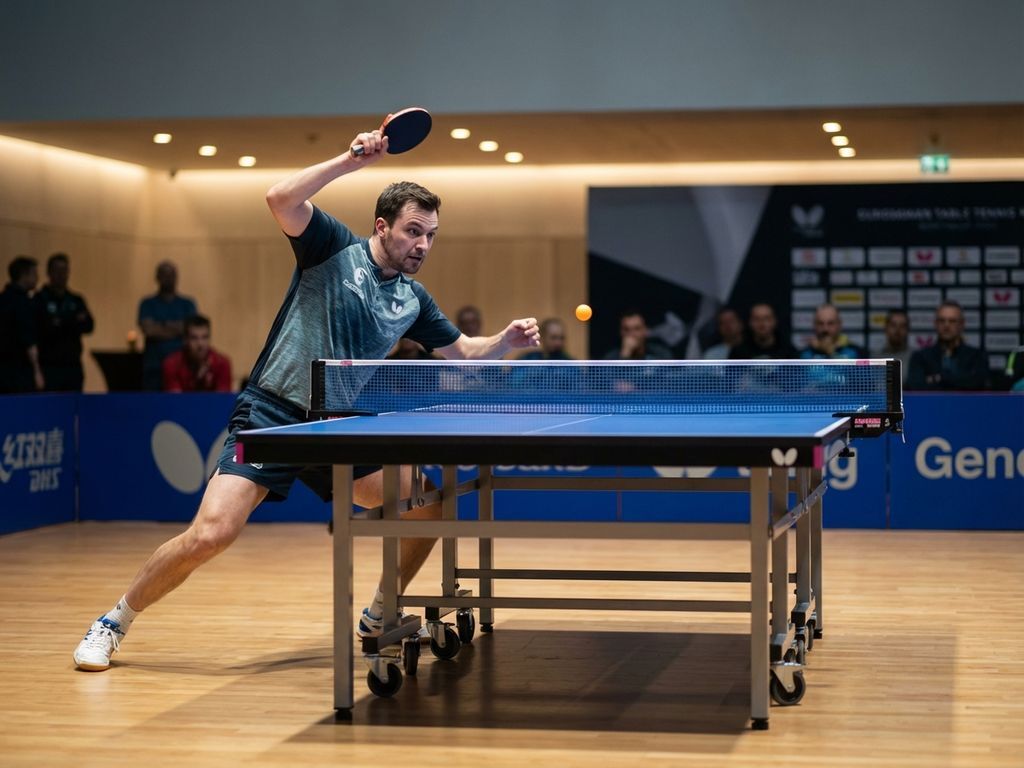
A game of ping pong goes to 11 points, and you must win by 2. Each player serves two points in a row. Official matches follow the standards published in USA Table Tennis’s basic rules of table tennis.
The Basic Rules of Ping Pong
The rule numbers below come from the USA Table Tennis rulebook.
- Games to 11: A game is won by the first player to reach 11 points with a 2-point lead (rule 2.11.1).
- Two serves each: Players serve two points in a row, switching to single serves at 10-10 (rule 2.13.3).
- Odd game matches: Matches are the best of an odd number of games (rule 2.12.1), such as best of 5 or 7 in tournaments or best of 3 in casual play.
- Open-palm toss: The server tosses the ball upward at least 6 inches from a flat palm without spin before striking it (rules 2.6.1 and 2.6.2).
- Serve bounce sequence: The served ball must bounce once on the server’s side and then once on the receiver’s side (rule 2.6.3).
- Net lets: A serve that touches the net assembly and lands correctly is replayed without penalty (rule 2.9.1.1).
- Rally returns: A return must touch the opponent’s side, either directly or after clipping the net (rule 2.7.1).
- Faults and lost points: Missing a return, touching the net, putting a free hand on the table, or hitting the ball twice on purpose forfeits the point (rule 2.10.1).
- No volleying: Touching the ball before it bounces while it is over or heading toward your side costs you the point (rule 2.5.8).
8 ping pong social clubs · US & Toronto
Bring your group to SPIN
Ping pong tables for up to 10, party packages, and private events with food, drinks and a DJ. Pick your city to book.
Ping Pong Serving Rules
Every legal serve starts with an open-palm toss of at least 6 inches. Service begins with the ball resting on a stationary, flat palm (rule 2.6.1). The server tosses the ball upward at least 16 centimeters without spin and strikes it as it descends (rules 2.6.2 and 2.6.3).
The ball must stay above table level and behind the server’s end line from the start of the serve until it is struck (rule 2.6.4). Servers cannot hide the ball with their body, arms, or clothing. Once the ball is tossed, the server must move their free arm away from the space between the ball and the net (rule 2.6.5).
A serve is illegal if the toss rises less than 6 inches (16 cm), if the toss carries spin, or if the server hides the ball from the receiver. It is also illegal if the ball drops below table level or moves in front of the end line before it is struck, and an illegal serve loses the point.
In singles, the serve must touch the server’s side first and then the receiver’s side (rule 2.6.3). In doubles play, the serve must bounce in the server’s right half court and then land in the receiver’s right half court (rule 2.6.3). If a serve clips the net and lands in the proper court, it is ruled a let and replayed without penalty (rule 2.9.1.1).
How You Lose a Point
A player loses a point for a missed serve or return, for obstructing the ball, or for a fault such as touching the net or moving the table. Placing your free hand on the playing surface during a rally is a fault that awards the point to your opponent (rule 2.10.1.11). The free hand is the hand not holding the paddle.
Moving the table during a rally forfeits the point (rule 2.10.1.9). Touching the net with your body, clothing, or paddle results in the same penalty (rule 2.10.1.10). Players also lose the point if they deliberately strike the ball twice in a row (rule 2.10.1.7).
Obstruction occurs when you touch the ball before it bounces while it is over or heading toward your side (rule 2.5.8). You score if the opponent’s shot flies past your end line without touching your side (rule 2.10.1.4). Even if that out-of-bounds ball touches you after passing the end line, you win the point.
| Situation | Result | Rule |
|---|---|---|
| Serve clips the net and lands in | Replay (let) | 2.9.1.1 |
| Ball clips the net in a rally and lands in | Play on | 2.7.1 |
| You hit the ball before it bounces while it is over or heading toward your side | Opponent’s point | 2.5.8 |
| Opponent’s shot flies past your end line without touching your side | Your point | 2.10.1.4 |
| Your free hand touches the table | Opponent’s point | 2.10.1.11 |
| You move the table | Opponent’s point | 2.10.1.9 |
| You touch the net | Opponent’s point | 2.10.1.10 |
| You hit the ball twice on purpose | Opponent’s point | 2.10.1.7 |
A regulation table measures 9 feet long, 5 feet wide, and 2.5 feet high, with a 6-inch net dividing the surface. A racket must be black on one side and another approved color on the other, and the approved ball is the 40mm+ plastic ball.
Scoring, Games and Matches
Modern ping pong scoring awards games to the first player to reach 11 points with a margin of two points. Under USA Table Tennis rules, games go to 11 points, not 21 (see how ping pong scoring changed).
Service alternates every two points during regular play. If both players reach 10 points, service alternates after every single point until one competitor leads by two (rule 2.13.3).
A player does not need to serve to score a point. At the start of a match, who serves first is decided by lot, with the winner choosing to serve, receive, or pick a table end (rules 2.13.1 and 2.13.2).
Players change ends after each game (rule 2.13.7). The competitor who served first in one game receives first in the next game (rule 2.13.6). In the final possible game of a match, players change ends as soon as either side reaches 5 points (rule 2.13.7).
Doubles Rules
Doubles play requires players to serve diagonally from the right half court and alternate returns with their partner on every shot. The served ball must touch the server’s right half court first and then the receiver’s right half court (rule 2.6.3).
The server serves, the receiver returns, the server’s partner plays the third stroke, and the receiver’s partner plays the fourth stroke (rule 2.8.2). Striking the ball out of turn forfeits the point to the other pair (rule 2.10.1.12).
At each change of service, the previous receiver becomes the server, and the partner of the previous server becomes the receiver (rule 2.13.5).
Time Limits in Long Games
The expedite system activates if a single game remains unfinished after 10 minutes of play, unless at least 18 total points have already been scored (rules 2.15.1 and 2.15.2). Both competitors can also request the expedite system at any point during a match. Once expedite rules take effect, each player serves for one point in turn, and the receiver wins the point if they make 13 correct returns in a rally (rule 2.15.4).
Playing Ping Pong at SPIN
At SPIN, we are the original ping pong social club, founded in New York City about 15 years ago. Today, we welcome players across eight locations: Boston, Chicago, New York Flatiron, New York Midtown, Philadelphia, San Francisco, Seattle, and Toronto. Every venue pairs ping pong with a full-service restaurant and craft cocktail bar.
Guests play with standard Stiga paddles and unlimited balls, with options to upgrade to a Stiga Pro Carbon paddle. During organized events, SPIN Pros lead competitions, tournaments, and social play. Planners can review 12 ping pong tournament formats to organize brackets for group outings.
Coworkers and friends will enjoy ping pong and great food together. Party planners at each venue handle your event so that you can relax and enjoy. You can plan corporate events for your group.
For a casual game, play to 11 and win by 2, with two serves each. Toss from an open palm behind the end line, and let the serve bounce once on each side. A serve that clips the net and lands in is replayed. Groups can agree on their own house rules for casual play, but sanctioned play uses USA Table Tennis rules. To play your next match, choose your venue and find the SPIN nearest you.
Frequently Asked Questions
Can you hit a ping pong ball before it bounces?
No, you cannot hit a ping pong ball before it bounces while it is over the table or traveling toward your side. Touching the ball early counts as an obstruction fault under rule 2.5.8 and gives the point to your opponent. If the opponent’s shot passes beyond your end line without touching your court, you score the point even if the ball touches you.
Can you lose on a serve in ping pong?
Yes, you can lose a point on your own serve in ping pong. Failing to make a correct serve awards a point directly to your opponent under rule 2.10.1. A player does not have to win on their own serve to score, and a serve that touches the net before landing in court is replayed as a let.
Can you touch the table in table tennis?
You cannot touch the playing surface with your free hand during a rally. Rule 2.10.1.11 states that touching the table with your free hand forfeits the point to your opponent. Moving the playing surface with your body or equipment also costs you the point under rule 2.10.1.9.
What are illegal serves in table tennis?
An illegal serve occurs when a server puts spin on the toss, hides the ball, or tosses it less than 6 inches upward from an open palm. It is also illegal to let the ball drop below table level or move in front of the end line before it is struck. Any service violation awards the point directly to the receiver.
Can you hit your side of the table in ping pong?
No, a returned ball cannot touch your own side of the table during an active rally. Under rule 2.7.1, a return must touch the opponent’s court, either directly or after touching the net. The only time your own shot bounces on your side is the serve, which must touch your side first and then the receiver’s side (rule 2.6.3).
Does ping pong go to 11 or 21?
Standard ping pong games go to 11 points under official regulations. A player or pair must win by at least two points, meaning a 10-10 tie extends play until one side establishes a two-point margin. Each player serves two points in turn, switching to single alternating serves at 10-10.
What are the rules for serving in ping pong?
The rules for serving require tossing the ball upward at least 6 inches from an open, stationary palm behind the end line. The ball must stay above table level and remain visible to the receiver before the paddle strikes it. A legal serve must bounce once on the server’s side and then once on the receiver’s side, with net clips that land in court replayed as lets.