The best inclusive holiday activities for diverse workplace teams are ones that invite participation without requiring a specific skill level, cultural background, or physical ability. Activities like social ping pong, trivia nights, cooking classes, and creative challenges work well because they are accessible, low-pressure, and naturally encourage conversation across teams. This article unpacks the most common pitfalls of workplace holiday events and walks through practical strategies for creating celebrations that genuinely bring people together.
Why do traditional holiday parties often leave employees feeling excluded?
Traditional holiday parties tend to exclude employees because they are built around a narrow set of assumptions: that everyone drinks alcohol, celebrates the same holidays, enjoys the same music, or feels comfortable in loud, crowded settings. When an event caters only to the majority experience, employees who fall outside that default often feel like afterthoughts rather than valued members of the team.
The format itself can also be a barrier. Events structured around passive mingling in a formal venue place the social burden entirely on the individual. Employees who are introverted, newer to the team, or simply less comfortable in unstructured social situations have no natural entry point into conversation. Without a shared activity to anchor the experience, these gatherings can feel more like an obligation than a celebration.
Religious and cultural dimensions add another layer. Framing a December event as a "Christmas party" signals to employees who observe different traditions that the celebration was not designed with them in mind. Even well-intentioned gestures like Secret Santa or specific holiday decor can create subtle feelings of exclusion for those who do not share the same background.
What makes a workplace holiday activity truly inclusive?
A truly inclusive workplace holiday activity is one where every participant, regardless of skill level, background, physical ability, or personality type, can engage meaningfully and feel genuinely welcome. Inclusivity in this context is not about removing all structure; it is about designing an experience that offers multiple ways to participate so no one is left on the sidelines.
Several qualities define an inclusive team celebration:
- Low barrier to entry: The activity does not require prior experience, specialized knowledge, or a particular physical ability to enjoy.
- Multiple modes of participation: Guests can choose how involved they want to be, from active competitors to casual spectators or social participants.
- Culturally neutral framing: The event is positioned as a year-end or winter celebration rather than tied to a specific religious holiday.
- Alcohol-optional environment: Non-alcoholic beverages are genuinely available and visible, not an afterthought.
- Structured social anchors: Activities give people something to do together, reducing the awkwardness of unstructured mingling.
When these elements are present, employees across different departments, seniority levels, and backgrounds are far more likely to connect authentically rather than clustering with the people they already know.
What are the best inclusive holiday activities for diverse workplace teams?
The best inclusive holiday activities for diverse workplace teams combine light competition, social interaction, and flexibility so that employees can participate at their own comfort level. Activities that are easy to learn, fun to watch, and adaptable to mixed groups consistently outperform formal dinners or passive networking events.
Here are strong options worth considering for corporate holiday party ideas:
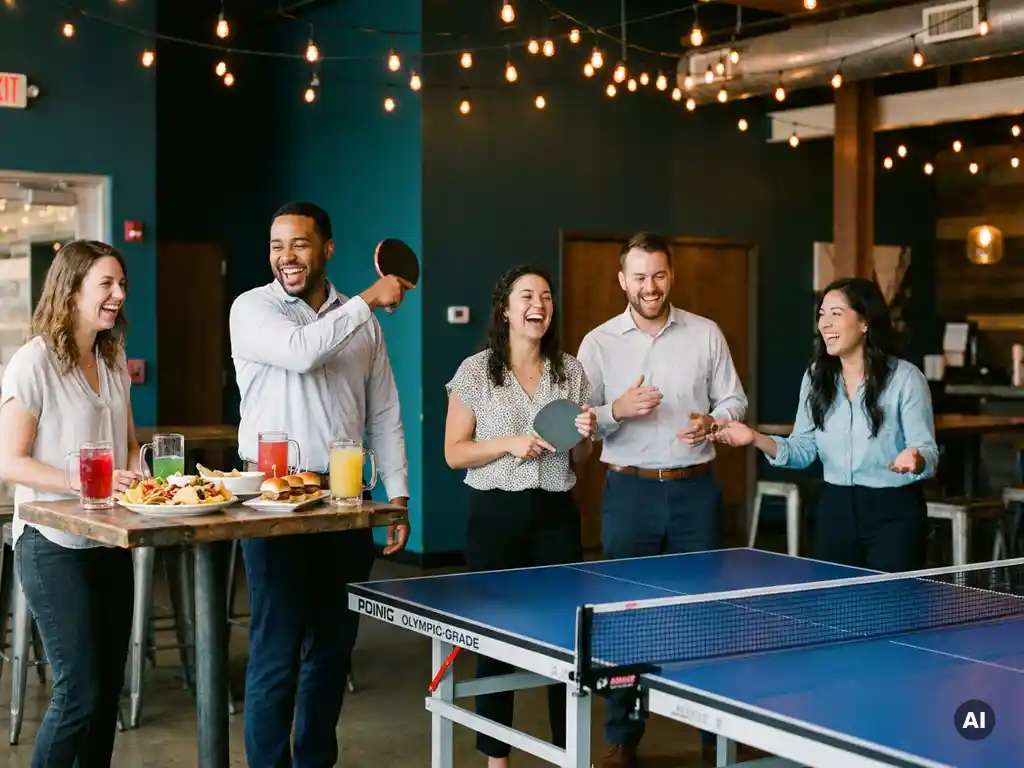
- Social ping pong: Accessible to beginners and enjoyable for experienced players alike, ping pong creates natural one-on-one and small-group interactions. It is easy to rotate partners, run friendly tournaments, or simply rally casually at the side of the table.
- Team trivia: Trivia works across age groups and backgrounds because it rewards a wide range of knowledge. Mixed-department teams encourage cross-company connections.
- Collaborative cooking or food experiences: Shared meals and food-focused activities are universally social and can be adapted for dietary preferences.
- Large-format board games: Games like Jenga, Connect 4, and Uno scale well for groups and require no physical exertion or prior skill.
- Creative workshops: Art, craft, or design challenges give quieter employees a way to engage without needing to be the loudest voice in the room.
The most effective holiday activities for employees tend to mix structured play with open social time, giving people a reason to interact without forcing it.
How can HR teams balance fun and professionalism at holiday events?
HR teams can balance fun and professionalism at holiday events by choosing venues and formats that feel vibrant and social without crossing into environments that make employees uncomfortable. The goal is a setting that signals "this is a real celebration" while still reflecting the values and standards of the organization.
Practical ways to strike that balance include:
- Choosing a venue that has energy and atmosphere built in, so the event does not rely solely on alcohol to create a mood.
- Offering structured activities alongside free social time, so employees have natural conversation starters.
- Setting a clear tone in the invitation that communicates the event is celebratory but still a company function.
- Working with a venue that provides dedicated event planners, so logistics are handled professionally and HR teams are not managing the event in real time.
- Ensuring food and non-alcoholic options are prominent, not secondary to the bar.
A team-building holiday party succeeds when employees leave feeling genuinely celebrated rather than simply having attended an obligation. The venue and format do much of that work before a single employee walks through the door.
How do you accommodate employees with different preferences and abilities?
Accommodating employees with different preferences and abilities at a holiday event requires building flexibility into the format from the start rather than making accommodations reactively. The most effective approach is designing an event with multiple participation modes so that no single format is the only way to engage.
For physical accessibility, venues should be evaluated for mobility access, seating availability throughout the space, and activities that can be enjoyed from a seated position. Ping pong, for example, can be adapted and is actively used in therapeutic settings for people with motor conditions, which speaks to its broad accessibility.
For personality-based preferences, the key is providing both active and passive engagement options. Not every employee wants to compete or perform in front of colleagues. Spaces with lounge seating, bar areas, and side activities let introverts engage socially on their own terms while competitive employees enjoy structured play.
For dietary and alcohol preferences, work with venues that offer chef-driven menus with clearly labeled options and a beverage program that treats non-alcoholic choices with the same care as cocktails. When spirit-free options are genuinely appealing rather than an obvious substitute, employees who do not drink feel included rather than accommodated.
When should companies book a venue for a holiday team event?
Companies should book a venue for a holiday team event at least six to eight weeks in advance, and ideally earlier for large groups or events planned for peak December dates. Popular venues fill quickly in the final quarter of the year, and the best private event spaces are often reserved months ahead by organizations that plan early.
For corporate holiday parties in 2026, HR teams and event planners should aim to confirm venue bookings by mid-October at the latest if the event falls in November or December. Groups larger than 50 people, events requiring customized catering, or functions that need dedicated private space should start the conversation even earlier to secure preferred dates and packages.
Early booking also gives event planners more flexibility to customize the experience. When a venue is not under pressure to fill a last-minute slot, there is more room to discuss menu preferences, activity formats, layout configurations, and any accessibility requirements the team may have. Rushing the booking process often means settling for whatever remains available rather than designing the event around what the team actually needs.
How SPIN helps with inclusive holiday activities for diverse workplace teams
We bring together everything a corporate holiday event needs in one venue, making it easier for HR teams and event planners to deliver an inclusive, memorable celebration without managing multiple vendors. Here is what we offer:
- Olympic-grade ping pong tables that welcome players of every skill level, from first-timers to competitive players
- Multiple participation modes including active play, large-format board games, bar seating, and lounge areas so every employee finds their comfort zone
- Chef-driven menus with shareable, locally sourced food and a beverage program that includes seasonally inspired cocktails and spirit-free options
- Dedicated event planners who handle logistics from start to finish, so your team can focus on enjoying the event
- Private event spaces across major North American cities, including New York, Chicago, San Francisco, Philadelphia, Boston, Seattle, and Toronto, accommodating groups of all sizes
- Rotating DJs and vibrant atmosphere that create energy without requiring a formal program
Whether you are planning an intimate team gathering or a large-scale company celebration, we make it straightforward to host a holiday event that genuinely includes everyone. Book your corporate holiday event with us and let our team help you create a celebration your employees will actually look forward to.