Making a holiday work event accessible for all employees means designing every element, from the activity to the menu to the venue, so that no one feels left out, uncomfortable, or unable to participate. The key is choosing an environment that removes barriers rather than creating them, where participation is flexible and the atmosphere welcomes every personality and ability. The questions below walk through exactly how to do that.
What makes a holiday work event truly inclusive for all employees?
A truly inclusive holiday work event gives every employee a genuine way to participate, regardless of their personality, physical ability, dietary needs, or comfort with social settings. Inclusivity is not just about removing obstacles. It is about actively designing an experience where different people can engage on their own terms and still feel like part of the group.
The most common mistake event planners make is treating inclusion as a checklist item rather than a design principle. An event can technically accommodate a wheelchair user but still feel unwelcoming if the layout clusters everyone at high-top tables. It can offer a vegetarian option but still feel exclusionary if it is the only dish labeled as an alternative. True inclusion is woven into every decision, not bolted on at the end.
Start by surveying employees before the event. A short anonymous form asking about dietary restrictions, mobility considerations, and activity preferences gives you actionable data and signals to your team that their comfort genuinely matters. From there, build an event structure that has multiple points of entry, meaning guests can arrive, engage, step back, and re-engage without missing anything or feeling awkward for doing so.
What types of activities work for employees of all skill levels?
Activities that work for employees of all skill levels are those with a low barrier to entry, a flexible level of competitiveness, and a social component that does not depend on winning. Games that are easy to learn but still engaging reward participation over expertise, which keeps both first-timers and seasoned players equally invested.
Ping pong is a strong example of this balance. Almost anyone can pick up a paddle and rally within minutes, and the game naturally encourages conversation and laughter between points. It scales well too. Casual players can enjoy a relaxed back-and-forth while more competitive colleagues can run a friendly tournament bracket on the same tables. The activity does not split the room into those who are good and those who are watching.
Other activities that follow the same principle include large-format games like Jenga, Connect 4, and Uno, which require no physical training and carry no learning curve. These kinds of games create natural gathering points where employees who prefer to socialize without competing can still be part of the action. The goal is to have enough variety that every guest finds something that feels right for them.
How do you accommodate employees with different physical abilities?
Accommodating employees with different physical abilities at a corporate holiday party requires attention to venue layout, activity options, and the overall flow of the event. Physical accessibility goes beyond ramp access. It includes seating availability, surface types, noise levels, and whether the event's main activities can be adapted for guests who have limited mobility or stamina.
When evaluating a venue, confirm that all areas guests will use, including the bar, dining space, restrooms, and activity zones, are reachable without navigating stairs or narrow corridors. Check that there is ample seating throughout, not just at designated dining tables, so guests who cannot stand for long periods can still be near the activity rather than sidelined from it.
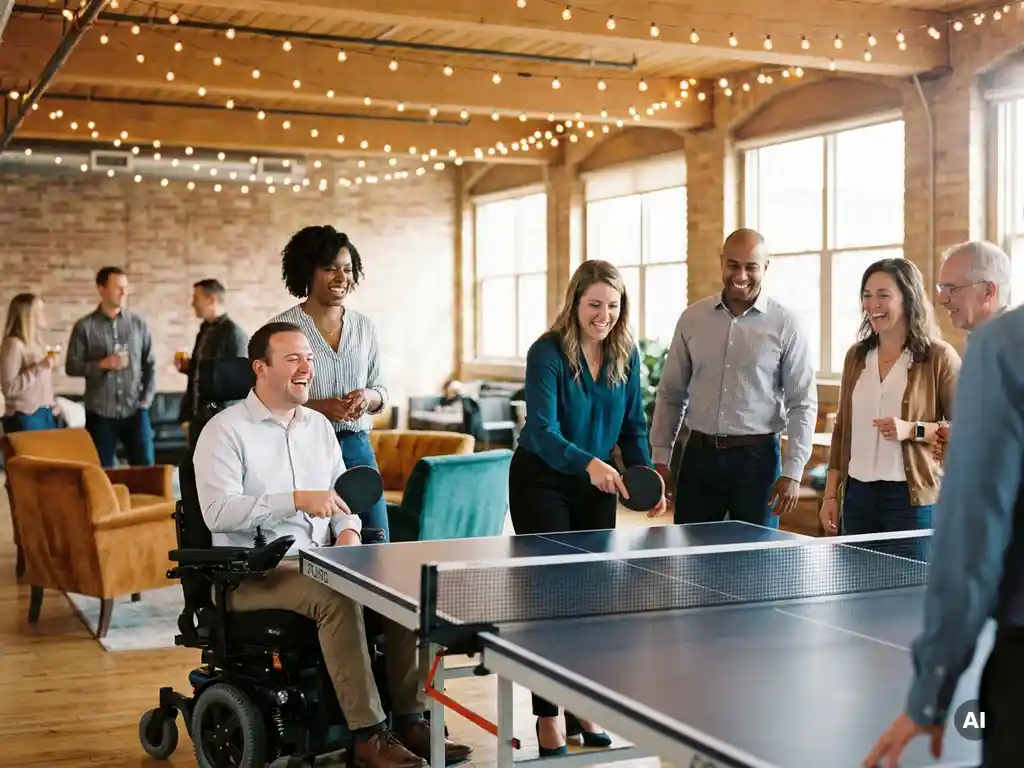
For activities like ping pong, consider that the game can be played at varying intensity levels and that guests who cannot stand for extended periods may still be able to participate in shorter rallies or take on a coaching or scoring role. Providing clear options, without making anyone feel singled out, is the standard to aim for. Communicate activity details in advance so employees can plan how they want to engage before they arrive.
How can you balance fun and professionalism at a company holiday event?
Balancing fun and professionalism at a company holiday event means choosing a setting and format that feels energetic and social without losing the structure that makes guests feel safe and respected. The venue, the activity, and the event flow all contribute to this balance. A well-chosen environment does the heavy lifting so the organizer does not have to police the atmosphere.
Venues that specialize in social entertainment, rather than traditional banquet halls or conference rooms, tend to strike this balance more naturally. They are designed to encourage interaction and movement while still providing the kind of service, food quality, and aesthetic polish that corporate guests expect. The physical environment signals the tone before anyone has said a word.
On the programming side, a loose structure works better than a rigid agenda. Having a few anchor moments, like a welcome toast, a group activity, and a shared meal, gives the event shape without making it feel like a meeting. Leave plenty of unstructured time for organic conversation, because that is often where the most meaningful team connections happen.
What food and drink options keep a holiday event inclusive?
Food and drink options that keep a holiday event inclusive are those that offer genuine variety across dietary needs, not just token alternatives. A strong menu for an inclusive office party includes clearly labeled options for common dietary restrictions, non-alcoholic beverages that are as thoughtfully crafted as the cocktail list, and shareable formats that encourage communal eating rather than isolating individual plates.
Shareable, snackable food works particularly well at active events because guests can eat between rounds of play or during conversation without needing to commit to a sit-down meal. Chef-driven menus that use locally sourced ingredients tend to feel more considered and less generic, which reflects well on the company hosting the event.
For beverages, offering spirit-free options that go beyond soda or water is increasingly important. Seasonal mocktails and non-alcoholic craft options allow employees who do not drink alcohol, whether for health, personal, or religious reasons, to participate in the social ritual of clinking glasses and trying something new. A full-service bar that treats non-alcoholic options with the same creativity as its cocktail menu signals that every guest was thought of.
How do you choose a venue that supports an accessible holiday event?
Choosing a venue that supports an accessible holiday event means evaluating the space against a clear set of criteria: physical accessibility, activity variety, catering flexibility, staff support, and the overall atmosphere. The right venue removes logistical complexity from the planner and creates a self-contained experience that works for a diverse group of employees.
Look for venues that offer all-in-one solutions, meaning food, beverages, entertainment, and event coordination are handled in one place. Managing multiple vendors increases the risk of gaps in service and puts more coordination burden on the event planner. A venue with on-site catering, a full bar, and built-in entertainment options simplifies execution significantly.
Also consider the scale and flexibility of the space. A venue that can host an intimate team dinner in one corner while running a ping pong tournament in another gives different employee groups the freedom to engage how they want. Spaces between 10,000 and 18,000 square feet, with multiple activity zones and seating configurations, tend to offer this kind of flexibility without feeling overwhelming.
How SPIN helps with planning an inclusive holiday work event
SPIN is built for exactly this kind of event. Our venues across New York, Chicago, San Francisco, Toronto, Philadelphia, Seattle, and Boston are designed to bring diverse groups of people together through ping pong, great food, and a vibrant atmosphere that feels social without being overwhelming. Here is what we offer for corporate holiday parties:
- Olympic-grade ping pong tables with Stiga equipment, accessible to players of every skill level
- Chef-driven, shareable menus with locally sourced ingredients and options for a range of dietary needs
- Thoughtfully crafted cocktails and spirit-free beverages so every guest has something worth raising a glass to
- Large-format social games like Jenga, Connect 4, and Uno for guests who prefer lower-intensity activity
- Dedicated event planners who manage the details so your team can focus on enjoying the evening
- Flexible private event spaces that scale from small team gatherings to large company-wide celebrations
- Family-friendly daytime hours and 21+ evening programming to suit different event formats
If you are planning a corporate holiday party that every employee will actually enjoy, we would love to help you put it together. Reach out to our events team to explore packages, availability, and how we can customize the experience for your group.