Yes, holiday activities can absolutely replace expensive gifts for children, and for many families, experiences prove to be the more meaningful choice. Children often remember shared adventures and quality time with loved ones far longer than they remember individual toys or gadgets. This article explores the key questions families ask when deciding between experiences and gifts, covering everything from child development to budget comparisons and practical activity ideas.
What do children value more — experiences or gifts?
Children tend to value experiences more than gifts, even if they do not always express this immediately. While a new toy generates excitement in the moment, shared experiences create memories that children carry with them for years. The emotional richness of doing something together as a family consistently outweighs the novelty of a physical object, which often fades within days or weeks.
This is not just intuition. Child development experts and family psychologists widely observe that children place enormous value on parental attention and presence. When a gift is given, the child receives an object. When an experience is shared, the child receives time, connection, and a story they can retell. The anticipation of an activity, the experience itself, and the conversations that follow all extend the emotional value well beyond what any wrapped box can offer.
It is also worth noting that children's preferences shift with age. Younger children are often dazzled by the unwrapping ritual itself, while older children and teenagers increasingly appreciate novelty, adventure, and social experiences. Designing holiday activities that suit your child's age and personality tends to land far better than a generic gift chosen under time pressure.
What types of holiday activities can replace gift-giving?
The best holiday activities to replace gifts are ones that involve active participation, shared challenge, and genuine fun for everyone involved. Options range from outdoor adventures and creative workshops to sports-based social experiences and cultural outings. The key is choosing something that pulls the family together rather than something each person does alone.
- Active social sports: Activities like ping pong, bowling, or mini golf create natural competition and laughter without requiring any prior skill.
- Creative workshops: Cooking classes, pottery sessions, or art workshops give children something tangible to take home alongside the memory.
- Cultural experiences: Museum visits, live performances, or interactive science centres spark curiosity and conversation.
- Outdoor adventures: Hiking, ice skating, or nature trails offer physical engagement and a change of scenery from the usual holiday routine.
- Game-based venues: Social entertainment spaces that combine multiple games, food, and atmosphere give families hours of shared fun in one location.
The most successful replacements for gifts are activities where children feel genuinely engaged rather than dragged along. Involving kids in choosing the activity increases their excitement and investment in the experience before it even begins.
How do shared family activities affect children's development?
Shared family activities support children's development across multiple dimensions, including emotional resilience, social skills, communication, and physical coordination. When families engage in activities together, children observe how adults handle friendly competition, manage frustration, and celebrate others, all of which are powerful models for their own behaviour.
Active play in particular builds motor skills, spatial awareness, and reaction time. Games that involve strategy, like ping pong or chess, also strengthen concentration and decision-making. Beyond the cognitive benefits, shared activities create a sense of belonging that psychologists consistently link to higher self-esteem and emotional security in children.
Family activities also give children a context in which to interact with adults as participants rather than just as authority figures. Playing a game alongside a parent or grandparent on equal footing builds confidence and reinforces the idea that adults enjoy play too. This normalises a healthy relationship with leisure and physical activity that children are likely to carry into adulthood.
Are holiday experiences actually cheaper than buying gifts?
Holiday experiences can be significantly cheaper than buying gifts, especially when you factor in the cumulative cost of multiple presents for multiple children. A single shared experience, such as a family outing to a social entertainment venue, a day trip, or a creative class, often costs less than the combined spend on individual gifts and delivers far more collective value.
Gift spending tends to expand invisibly. Parents often buy several smaller items alongside a main gift, add gift wrapping, and then repeat the process for each child. When totalled, the spend can be surprisingly high for items that lose their appeal quickly. A well-chosen family experience, on the other hand, represents a single cost that every family member benefits from simultaneously.
That said, experiences vary widely in price. Budget-conscious families can find excellent options at low cost, including free museum days, community events, and parks. Mid-range options like ping pong table reservations at a social venue offer structured fun with food and atmosphere at a predictable price. The important thing is to match the activity to what your family genuinely enjoys rather than choosing the most impressive-sounding option.
How do you make a holiday activity feel special for kids?
To make a holiday activity feel special for children, build anticipation, add personal touches, and frame the experience as an occasion rather than just an outing. Children respond strongly to ritual and presentation, so the way you introduce and surround an activity matters almost as much as the activity itself.
Build anticipation before the day
Give children a hint or a small clue about what is coming rather than revealing everything at once. A handwritten note, a countdown, or a themed envelope with a "ticket" inside transforms an ordinary outing into an event. Children who feel the build-up experience more excitement and are more emotionally invested when the day arrives.
Create rituals around the experience
Pair the activity with a tradition that becomes part of the memory: a special breakfast beforehand, a favourite playlist for the journey, or a dessert stop on the way home. These surrounding rituals become part of the story children tell later. "We always got hot chocolate after" is the kind of detail that makes a family memory feel unique and irreplaceable.
What holiday activities work best for mixed-age family groups?
The best holiday activities for mixed-age family groups are ones with adjustable difficulty, natural downtime built in, and something for everyone to do at once. Activities that require everyone to be equally skilled or equally energetic tend to leave someone behind. The sweet spot is a venue or experience where a six-year-old and a sixty-year-old can both have genuine fun without anyone having to slow down or speed up for the other.
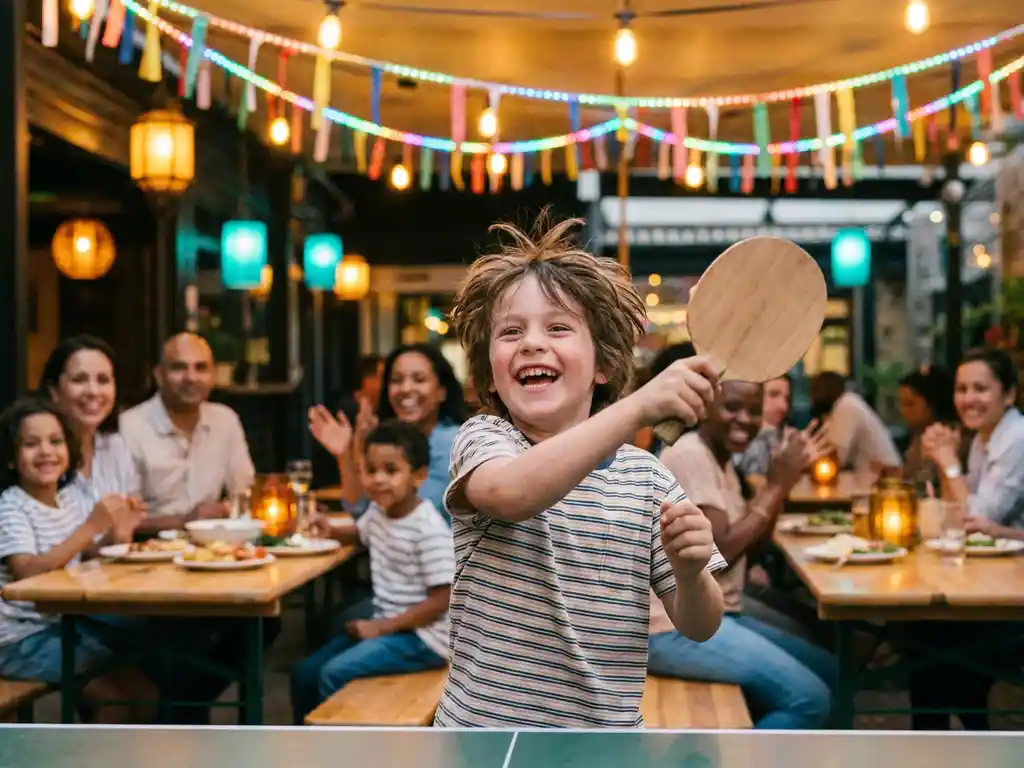
Ping pong is a particularly strong choice for mixed-age groups because the game scales naturally. Younger children can rally back and forth at a relaxed pace while older family members play more competitively at adjacent tables. There is no waiting around, no age minimum for participation during daytime hours, and the social nature of the game keeps everyone engaged even when they are not actively playing.
Large-format social games like Uno, Connect 4, and Jenga work similarly well, offering easy entry points for younger children while still entertaining adults. Venues that combine multiple activity types, along with shareable food and a relaxed seating area, allow different family members to drift between playing, eating, and watching without anyone feeling left out. The key is flexibility: the best mixed-age experiences have no single fixed pace.
How SPIN helps families create memorable holiday experiences
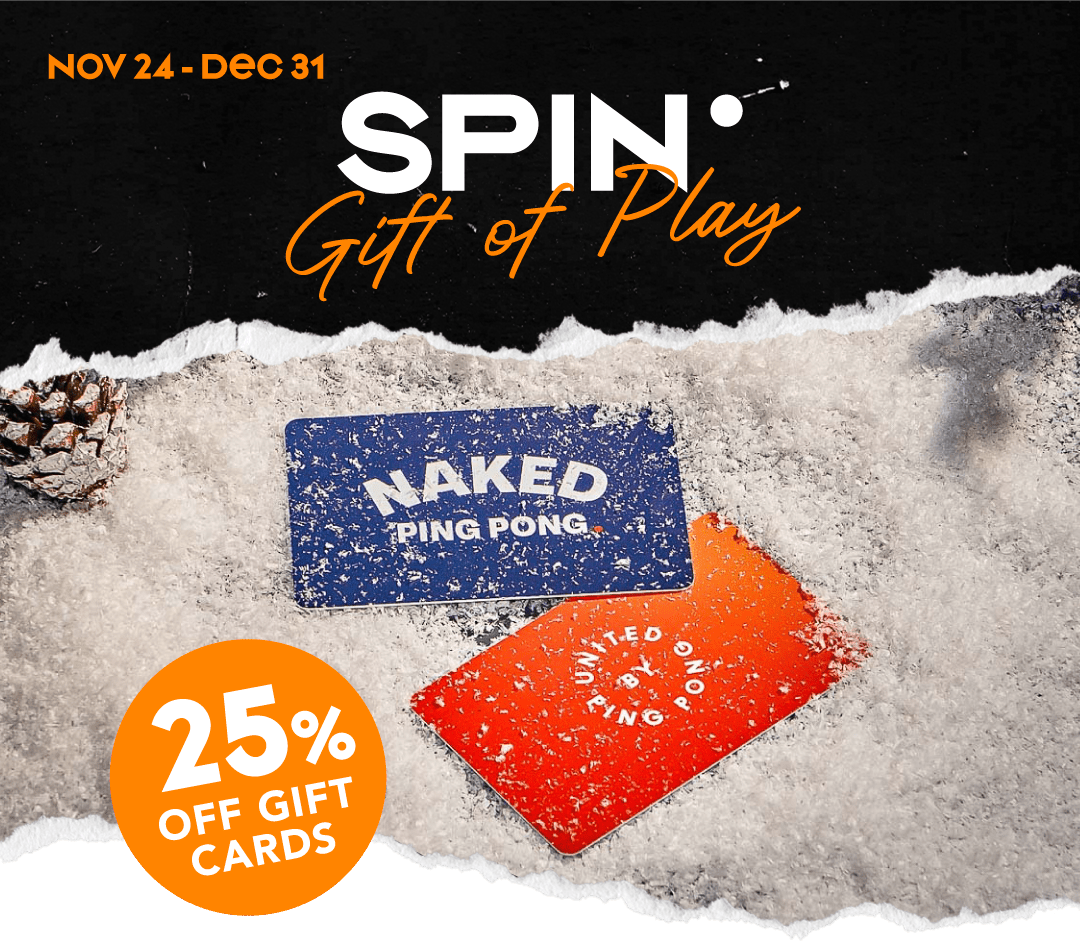
At SPIN, we have designed our venues specifically to bring families together around play, food, and great atmosphere, making us a natural fit for families looking to swap expensive gifts for something everyone will actually remember.
- Olympic-grade ping pong tables equipped with premium Stiga paddles, suitable for all skill levels from first-timers to competitive players.
- Mixed-age appeal with large-format social games like Uno, Connect 4, and Jenga alongside ping pong, so every generation has something to enjoy.
- Chef-driven shareable menus with locally sourced food and a full beverage selection, including non-alcoholic options, so the whole family can eat well together.
- Private party packages ideal for birthday celebrations and family milestones, with dedicated event planners to handle the details.
- On-site SPIN pros who can offer tips and engage with guests of all ages, adding something genuinely unique to the experience.
- Family-friendly daytime hours across locations in New York, Chicago, Boston, Philadelphia, San Francisco, Seattle, Washington, DC, and Toronto.
Ready to make this holiday unforgettable? Reserve your table online and give your family an experience worth talking about long after the season is over.