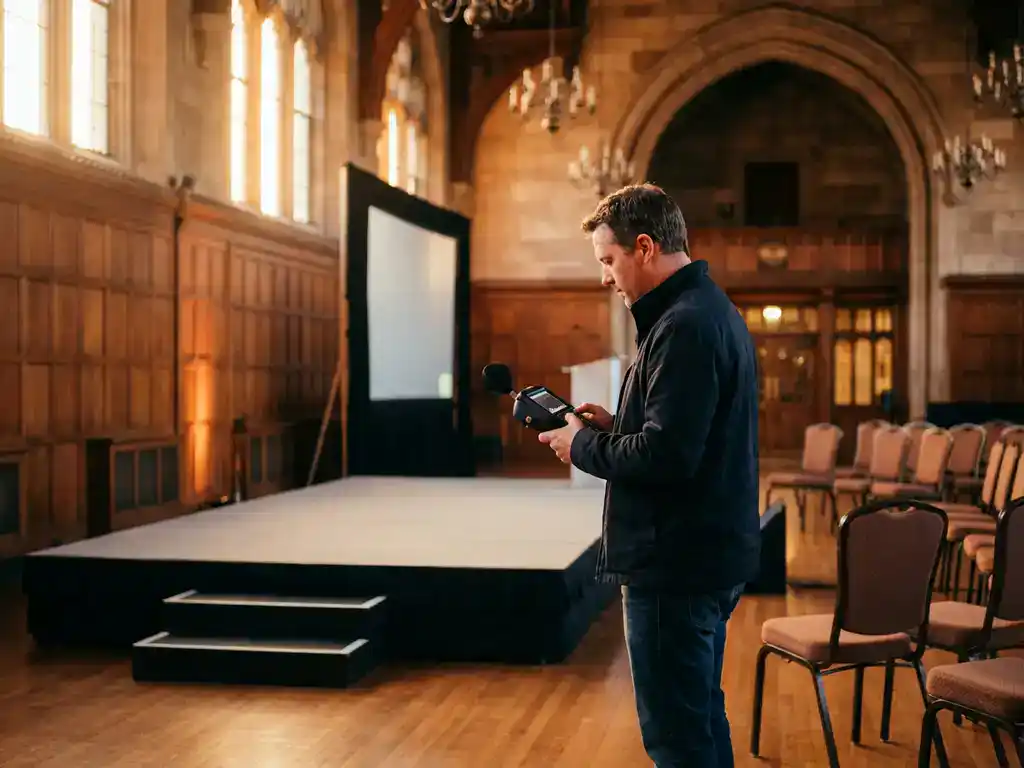
Evaluating venue acoustics for corporate presentations involves testing sound quality during site visits, checking for common problems like echo or outside noise, and understanding how architectural features affect audio clarity. Good acoustics ensure your speakers are heard clearly and your audience stays engaged throughout the event. This guide covers practical testing methods, warning signs to avoid, and solutions for optimising sound quality in any venue.
What makes venue acoustics important for corporate presentations?
Poor acoustics directly affect audience engagement, speaker confidence, and the professional perception of your event. When attendees struggle to hear clearly, they lose focus, check their phones, and miss important information. Speakers become frustrated trying to project over background noise or deal with echo, which undermines their delivery and your event’s credibility.
Sound quality affects how professional your corporate event appears. Muffled audio, feedback, or inconsistent volume levels create distractions that pull attention away from your message. Attendees associate poor sound with poor planning, which reflects negatively on your organisation and can affect business relationships.
Acoustic problems compound quickly during presentations. A speaker who can’t be heard clearly will raise their voice, causing strain and reducing their effectiveness. Audience members in different areas may have vastly different experiences, with some hearing perfectly while others miss entire sections. This creates an uneven experience that reduces the overall impact of your corporate event.
Good acoustics support natural conversation flow during the networking portions of corporate events. When people can speak at normal volumes and be understood easily, they’re more likely to engage authentically with colleagues and clients. This is particularly important for corporate event venues that blend presentation time with social interaction, whether that’s during formal networking sessions or casual activities like ping pong tournaments that encourage team building.
How do you test a venue’s acoustic quality before booking?
Visit the venue under conditions similar to your planned event and perform simple voice tests from different locations. Stand where speakers will present and talk at a normal volume while someone listens from various seating areas. Walk around the space while speaking to identify dead zones or areas with poor sound coverage.
Test the venue’s audio equipment if the venue is providing it. Ask staff to demonstrate the microphone system, speakers, and any available sound-mixing capabilities. Request a full sound check rather than just seeing the equipment, as problems often emerge when systems are actually running.
Pay attention to background noise levels during your visit. Note sounds from air-conditioning systems, outside traffic, neighbouring spaces, or kitchen areas. Ask venue staff about noise patterns throughout the day, as sound levels may increase during peak hours or when other events are running simultaneously.
Check the venue at different times, if possible. Sound behaves differently in empty versus occupied spaces, and background noise levels change throughout the day. If you can’t visit during peak conditions, ask detailed questions about how acoustics change when the space is full and other venue activities are happening.
Document your findings systematically. Take notes about sound quality from different positions, record brief audio samples on your phone, and ask specific questions about acoustic challenges the venue has experienced during similar corporate events.
What acoustic problems should you watch out for in event spaces?
Echo and reverberation create the most common acoustic issues in corporate event venues. These problems occur when sound bounces off hard surfaces like concrete walls, glass windows, or high ceilings, causing speech to become unclear and muddled. You’ll notice echo when words seem to repeat or overlap, making it difficult to follow presentations.
Outside noise interference can disrupt corporate presentations unexpectedly. Traffic sounds, construction work, other events in adjacent spaces, or even pedestrian areas can create competing audio that makes it hard for attendees to focus. This problem often worsens during peak business hours, when your corporate event is most likely to be scheduled.
HVAC system noise is a subtle but persistent acoustic problem. Air-conditioning units, ventilation fans, and heating systems create constant background noise that forces speakers to raise their voices and makes it harder for audiences to hear clearly. This type of noise fatigue reduces attention spans over time.
Poor sound distribution means some areas of the venue receive clear audio while others don’t. This commonly happens in long, narrow spaces or venues with unusual layouts where sound doesn’t travel evenly. Attendees in affected areas may struggle to participate fully in your corporate event.
Sound system feedback and technical issues can derail presentations entirely. Microphone feedback, speaker distortion, or inconsistent volume levels create professional embarrassment and lost time during corporate events. These problems often stem from inadequate equipment or poor system setup rather than the venue’s inherent acoustics.
Which venue features create the best acoustics for presentations?
Moderate ceiling heights between 10 and 14 feet provide optimal acoustic conditions for corporate presentations. Very high ceilings create echo and make voices sound distant, while extremely low ceilings can make spaces feel cramped and cause sound to become muffled. The right ceiling height allows sound to project clearly without excessive reverberation.
Carpeted floors and soft wall materials significantly improve acoustic quality by absorbing sound rather than reflecting it. Venues with fabric wall panels, curtains, or acoustic tiles reduce echo and create clearer speech intelligibility. Hard surfaces like concrete, tile, or bare walls should be balanced with sound-absorbing elements.
Rectangular room shapes typically provide better sound distribution than unusual layouts. Spaces that are roughly square or rectangular allow sound to travel more predictably, making it easier to position speakers and ensure even audio coverage. Avoid venues with many alcoves, columns, or irregular shapes that can create acoustic dead spots.
Appropriate seating arrangements support good acoustics by positioning attendees within optimal hearing ranges. Theatre-style seating works well for presentation-focused events, while round tables can create conversation pockets that may compete with speakers. Consider how the seating layout affects both sound projection and audience interaction for your specific corporate event needs.
Venues with dedicated sound systems designed for the space perform better than those using portable equipment. Built-in speakers positioned strategically around the room, proper mixing capabilities, and microphone systems designed for the venue’s specific acoustic properties provide more reliable audio quality for corporate presentations.
How can you improve acoustics in less-than-perfect venues?
Professional microphone systems can overcome many acoustic challenges in corporate event venues. Wireless lapel microphones allow speakers to move freely while maintaining consistent audio levels. Handheld microphones work well for Q&A sessions, while podium microphones suit formal presentations. Ensure backup microphones are available for important corporate events.
Strategic speaker placement helps distribute sound evenly throughout the venue. Work with venue staff or audio technicians to position speakers around the room rather than concentrating them in one area. This approach reduces dead zones and ensures attendees in different seating areas have similar audio experiences.
Sound-dampening techniques can reduce echo and improve clarity in problematic spaces. Portable acoustic panels, fabric banners, or even the strategic placement of corporate displays can absorb sound reflections. Some venues allow temporary modifications, such as adding tablecloths, fabric draping, or acoustic screens.
Room setup modifications can significantly influence acoustic performance. Arrange seating to bring attendees closer to speakers when possible. Use the venue’s smallest appropriate space rather than a large room that’s partially empty, as occupied spaces generally have better acoustics than empty ones.
Audio equipment rental provides professional-grade solutions when venue systems are inadequate. Rent complete sound systems, including mixing boards, wireless microphones, and properly positioned speakers. Professional audio technicians can operate equipment during your event, allowing you to focus on content rather than technical issues. Budget approximately $500-$2,000 for professional audio rental depending on venue size and equipment complexity.
Work closely with venue staff to optimise existing conditions. Ask about adjusting HVAC systems during presentations, closing doors to reduce outside noise, or using specific areas of larger venues that have better acoustic properties. Many corporate event venues have experience managing sound challenges and can offer practical solutions.
How Spin helps with venue acoustics
Spin provides the complete solution for corporate events with superior acoustics that enhance both presentations and interactive experiences. Our venues are specifically designed to deliver optimal sound quality while creating an environment where teams can connect through engaging activities like ping pong.
Here’s how Spin addresses common acoustic challenges:
- Purpose-built acoustic design: Our spaces feature optimal ceiling heights, sound-absorbing materials, and strategic layouts that ensure clear audio throughout
- Professional sound systems: Built-in audio equipment designed specifically for each venue’s acoustics, eliminating guesswork and technical issues
- Flexible event spaces: Rooms that can accommodate both formal presentations and interactive team activities without compromising sound quality
- Expert event support: Our team manages all technical aspects, allowing you to focus on your event content and objectives
- Comprehensive event solutions: From presentations to team-building activities, we provide everything needed for successful corporate events
Ready to host your next corporate event in a venue with perfect acoustics? Visit Spin to explore our locations and book your event today.