Holiday activities genuinely matter for children's development because play, especially during school breaks, is one of the most powerful ways kids build cognitive, emotional, and social skills. Structured and unstructured activities alike give children the space to explore, connect, and grow in ways that classroom learning simply cannot replicate. The questions below unpack exactly how and why holiday time is such a valuable developmental window for kids of every age.
What types of activities best support children's development during holidays?
The activities that best support children's development during holidays are those that combine social interaction, physical movement, creative thinking, and problem-solving. No single category wins outright, but research and child development expertise consistently point to activities that engage children actively rather than passively, and that involve other people rather than screens alone.
Holiday activities for children fall into a few broad categories, each offering distinct developmental benefits:
- Physical and movement-based activities such as sports, dance, and active games build motor skills, coordination, and physical confidence.
- Creative activities such as drawing, building, or storytelling develop imagination, self-expression, and the ability to think flexibly.
- Social games and group play teach turn-taking, communication, and how to handle winning and losing gracefully.
- Outdoor exploration supports curiosity, independence, and an appreciation for the wider world.
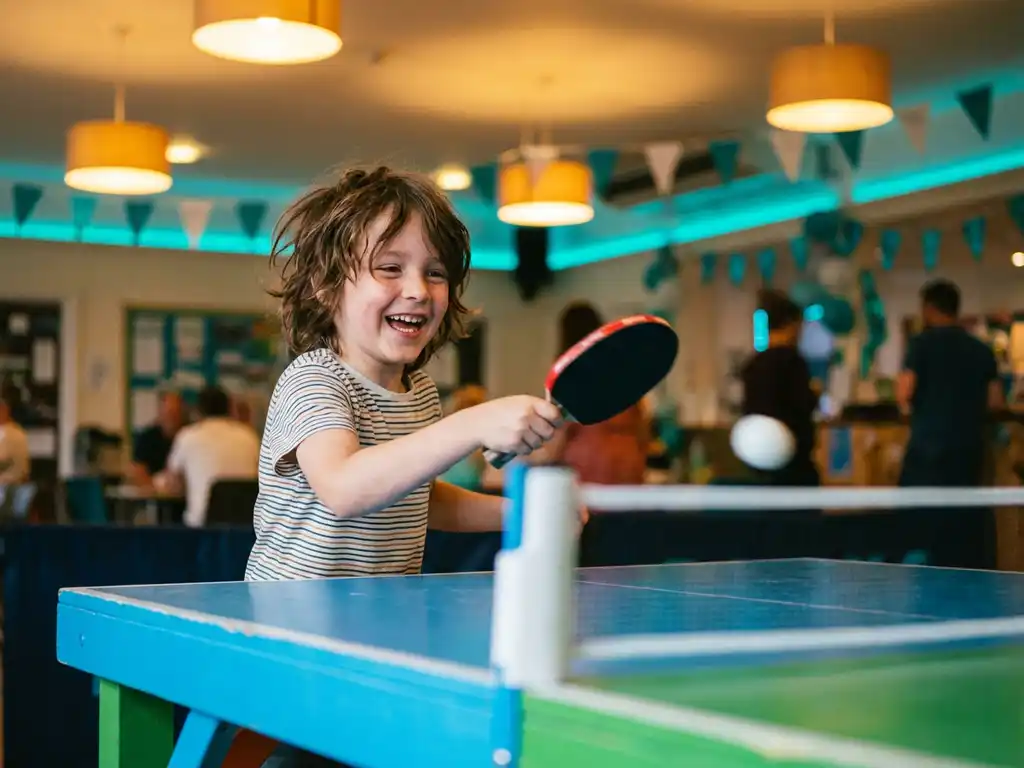
The most effective holiday fun for kids tends to blend more than one of these categories. A game of ping pong, for example, combines physical activity with social engagement and friendly competition, making it a particularly well-rounded choice for children during school breaks.
How does social play during holidays build children's emotional skills?
Social play during holidays builds children's emotional skills by placing them in real situations where they must manage feelings, read others' reactions, and respond appropriately. Unlike solo activities, social play creates immediate emotional feedback loops that help children practice empathy, frustration tolerance, and resilience in a low-stakes environment.
When children play together, they encounter moments that require genuine emotional work. A child who loses a round of a game must process disappointment. A child who wins must balance excitement with consideration for others. A child who joins a group of unfamiliar peers must manage nerves and find ways to connect. Each of these moments is a small but meaningful lesson in emotional regulation.
Holiday periods are especially valuable for this kind of growth because children have more time and freedom to engage in extended play without the pressure of school schedules. Longer, more relaxed social interactions allow emotional skills to develop more naturally than in brief, structured classroom settings. Kids' holiday activities that bring together children of different ages or backgrounds are particularly rich in this regard, as they expose children to a wider range of perspectives and social dynamics.
Why is unstructured play time important for kids on school breaks?
Unstructured play time is important for kids on school breaks because it allows children to direct their own learning, follow their curiosity, and develop independence. When children choose what to play and how to play it, they build decision-making skills, creativity, and intrinsic motivation that scheduled activities simply cannot provide in the same way.
During the school year, most of a child's day is organised for them. Breaks offer a rare opportunity for genuine autonomy. Child development experts consistently highlight free play as essential to healthy development, noting that it supports executive function, imagination, and the ability to manage boredom productively.
This does not mean holidays should be entirely unplanned. A balance works best: some family activities, some child-led free time, and some loosely structured outings that give children room to explore within a safe framework. The key is resisting the urge to fill every hour with organised programmes and trusting that children playing freely are doing important developmental work, even when it looks like they are simply having fun.
What role do family activities play in a child's social development?
Family activities play a central role in a child's social development by providing a safe, trusted environment in which children practice the social skills they will use throughout life. Interactions with parents, siblings, and extended family teach children how relationships work, how to communicate across generations, and how to navigate group dynamics with people they genuinely care about.
When families play together, children observe and absorb social behaviour modelled by adults. They see how adults handle disagreement, celebrate others' successes, and cooperate toward a shared goal. These observations are formative in ways that peer-only interactions are not, because adults bring a level of emotional maturity that helps children feel secure while they experiment with social behaviour themselves.
Family activities during holidays also strengthen attachment bonds, which are the foundation of a child's broader social confidence. A child who feels securely connected to their family is generally more willing to take social risks with peers, try new activities, and recover from social setbacks. In this way, time spent playing together as a family is not just enjoyable in the moment but a genuine investment in a child's long-term social development.
How can parents choose holiday activities that match their child's developmental stage?
Parents can choose holiday activities that match their child's developmental stage by considering three key factors: the child's current abilities, their emerging skills, and their social readiness. Activities that are slightly beyond a child's comfort zone but not overwhelming tend to be the most developmentally valuable, encouraging growth without causing frustration or anxiety.
A rough guide by age group helps:
- Young children (ages 3 to 6) benefit most from sensory play, imaginative games, and simple physical activities with clear rules. Short attention spans mean variety matters more than depth.
- Primary school children (ages 7 to 11) are ready for more complex games with rules, team activities, and creative projects that require planning and collaboration.
- Tweens and teenagers (ages 12 and up) thrive in activities that offer a degree of challenge, social connection with peers, and the opportunity to develop genuine competence in something they care about.
It is also worth considering temperament alongside age. A naturally competitive child may love activities with clear winners and losers, while a more sensitive child may flourish in cooperative games where the goal is shared rather than individual. The best kids' holiday activities are those that meet children where they are, not where adults assume they should be.
Where can families find holiday activities that benefit children of all ages?
Families can find holiday activities that benefit children of all ages in venues and spaces designed specifically to accommodate mixed age groups, varying skill levels, and multiple interests under one roof. The most effective options are those where parents and children can genuinely participate together rather than adults watching from the sidelines while children play separately.
Some of the most reliable sources for inclusive family activities include:
- Community recreation centres that offer open play sessions, family swim times, and multi-sport programmes accessible to all ages.
- Museums and science centres with hands-on exhibits that engage curiosity across generations.
- Social entertainment venues that combine active games, food, and a relaxed atmosphere so families can move between activities at their own pace.
- Outdoor parks and nature reserves where unstructured exploration is naturally available and free.
When evaluating any venue or programme, parents should look for environments where no prior experience is required, where children of different ages can participate meaningfully, and where the atmosphere feels welcoming rather than competitive or intimidating. The goal is a setting where the whole family can genuinely connect through shared activity.
How SPIN supports children's development through holiday activities
At SPIN, we have built our venues to be exactly the kind of place where family holiday activities come to life. Whether you are visiting with young children, teenagers, or a mix of both, we offer an environment where everyone can participate, compete, and connect at their own level.
Here is what makes SPIN a strong choice for families looking for meaningful holiday fun for kids:
- Olympic-grade ping pong tables suitable for all skill levels, from first-timers to experienced players, so no child or adult feels left out.
- Large-format social games including Uno, Connect 4, and Jenga, which are perfect for younger children and mixed-age groups.
- On-site SPIN pros who can offer tips, play alongside guests, and make the experience educational as well as entertaining.
- A chef-driven menu of shareable, snackable dishes that keeps the whole family fuelled without breaking the flow of play.
- Family-friendly daytime hours across all our locations, with a welcoming atmosphere designed for guests of all ages.
- Private party packages ideal for birthday celebrations and family milestones, with dedicated event planners to handle the details.
Reservations can be made easily online, with table bookings available for groups of up to 10 guests. Ready to make this holiday one your family will actually remember? Book a table at your nearest SPIN location and bring the whole family together over a game of ping pong.