The most effective way to keep employees engaged during corporate holiday events is to replace passive formats with interactive, activity-driven experiences that give people something to do together rather than just stand around. Engagement rises when employees feel like participants, not attendees. The sections below address the most common questions around planning a corporate holiday party that people actually enjoy.
What makes corporate holiday events fall flat for employees?
Corporate holiday events fall flat when they rely on passive formats that give employees little reason to interact. A cocktail hour with background music, a seated dinner with assigned tables, or a generic gift exchange rarely creates the kind of energy that makes people glad they showed up. The core problem is that traditional formats prioritize logistics over experience.
Several patterns consistently drain energy from corporate holiday parties:
- No structured activity: When there is nothing to do, conversation stalls and people default to checking their phones or leaving early.
- Seating that locks people in place: Long, formal dinners prevent mingling and reinforce office hierarchies rather than breaking them down.
- One-size-fits-all programming: Events that assume everyone wants the same thing, whether that is dancing, trivia, or a raffle, leave large portions of the group disengaged.
- No natural conversation starters: Without a shared activity, people default to talking only to colleagues they already know well.
The fix is not simply adding more entertainment. It is choosing formats that require participation, create natural moments of connection, and give people permission to be themselves outside of a work context.
What types of activities keep employees engaged at holiday parties?
Activities that combine light competition, skill accessibility, and social interaction keep employees most engaged at corporate holiday events. The best corporate holiday party activities are ones that anyone can join regardless of experience level, generate natural conversation, and do not require sustained attention to enjoy.
Some of the most consistently effective options include:
- Ping pong and paddle sports: Easy to learn, fast-paced, and naturally social. Games rotate quickly, so more people stay involved and no one is stuck watching for long.
- Giant lawn and table games: Oversized versions of classics like Jenga, Connect 4, or Uno create instant icebreakers without requiring any skill or preparation.
- Team-based challenges: Dividing groups into mixed teams encourages cross-departmental interaction and gives the event a loose competitive structure that builds energy over time.
- Live entertainment with interactive elements: DJs who read the room or performers who engage guests directly create atmosphere without demanding attention.
The common thread across all of these is that they are low-stakes and self-paced. Employees can engage as much or as little as they want, which makes the event feel inclusive rather than forced.
How do you balance fun and professionalism at a corporate holiday event?
Balancing fun and professionalism at a corporate holiday event comes down to choosing a venue and format that signals quality while removing the stiffness of a traditional office setting. The goal is an environment where leadership feels comfortable and employees feel free to relax.
A few principles help strike that balance:
- Choose a venue with inherent atmosphere: A space that already has good design, quality food, and professional service does the heavy lifting. You do not need to impose formality when the setting already communicates it.
- Use activity as a social equalizer: Games and interactive elements naturally flatten hierarchy. When a VP and a new hire are both beginners at ping pong, the dynamic shifts in a healthy way.
- Anchor the event with quality food and drink: A chef-driven menu and a well-curated bar signal that the company invested in the experience, which employees notice and appreciate.
- Set clear expectations around tone: A brief welcome from leadership that acknowledges the celebratory intent gives employees permission to enjoy themselves without second-guessing the vibe.
The mistake most planners make is treating professionalism and fun as opposites. They are not. The right venue and format make both feel effortless at the same time.
What's the difference between team building and employee appreciation events?
Team-building events are designed to develop collaboration, communication, and trust among colleagues, while employee appreciation events are designed to recognize and reward employees for their contributions. Both serve important purposes, but they have different goals and should be structured differently.
At a team-building event, the activity is the point. Structured challenges, problem-solving exercises, and competitive games are tools for developing skills and relationships that carry back into the workplace. Success is measured by what participants learn or experience together.
At an employee appreciation event, the experience itself is the reward. The focus shifts to hospitality, generosity, and giving employees a genuinely enjoyable time with no agenda attached. The goal is for people to leave feeling valued, not just entertained.
In practice, many corporate holiday parties blend both. A ping pong tournament creates team-building dynamics, while the overall evening, with great food, open bars, and a relaxed atmosphere, functions as appreciation. The key is knowing which goal takes priority so you can design the event accordingly and communicate its purpose clearly to attendees.
How do you keep a large group engaged throughout the entire event?
Keeping a large group engaged throughout an entire corporate holiday event requires a layered structure that gives people multiple ways to participate at different moments. No single activity holds everyone's attention for hours, so the most successful large-group events offer variety and let guests move between options naturally.
Practical strategies that work for large groups include:
- Stagger programming across the evening: Open with social time and lighter activities, build toward a peak moment like a tournament or group challenge, then wind down with music and mingling. This creates a natural arc that sustains energy.
- Create multiple activity zones: When guests can choose between ping pong tables, lounge seating with games, and bar areas, they self-select into the format that suits them. This prevents the dead zones that form when everyone is funneled into one space.
- Use rotating formats: Short games with quick turnover, like best-of-three ping pong matches, keep more people active and reduce the time anyone spends waiting on the sidelines.
- Anchor with live energy: A DJ or live entertainment running throughout the event maintains ambient energy even during transitions between activities.
- Build in a social anchor: A shared moment, such as a toast, a brief recognition segment, or a group game, gives the evening a focal point that brings everyone together before they scatter back into smaller conversations.
What should you look for in a venue for a corporate holiday party?
The best venues for corporate holiday parties combine built-in entertainment, high-quality food and beverage, flexible space, and dedicated event support under one roof. The fewer vendors you have to coordinate, the smoother the event runs and the less risk of something falling through the cracks.
Key criteria to evaluate when choosing a venue include:
- Dedicated event planning support: An on-site event planner who manages logistics so you do not have to is one of the highest-value features a venue can offer.
- Flexible capacity: The space should comfortably accommodate your group without feeling either cramped or cavernous. Venues in the 10,000 to 18,000 square foot range tend to work well for mid-to-large corporate groups.
- Built-in activity and entertainment: A venue that provides its own entertainment, whether that is ping pong tables, games, or DJs, eliminates the need to source and coordinate external vendors.
- On-site catering with quality menus: Chef-driven food programs with shareable, social formats fit corporate holiday events better than formal plated dinners because they keep people moving and mingling.
- Private event space options: The ability to reserve a dedicated area for your group, separate from the general public, gives your event a sense of exclusivity and makes logistics easier to manage.
- Accessibility and location: Choose a venue that is easy for employees to reach, especially in major metro areas where public transit matters.
How SPIN helps with corporate holiday party engagement
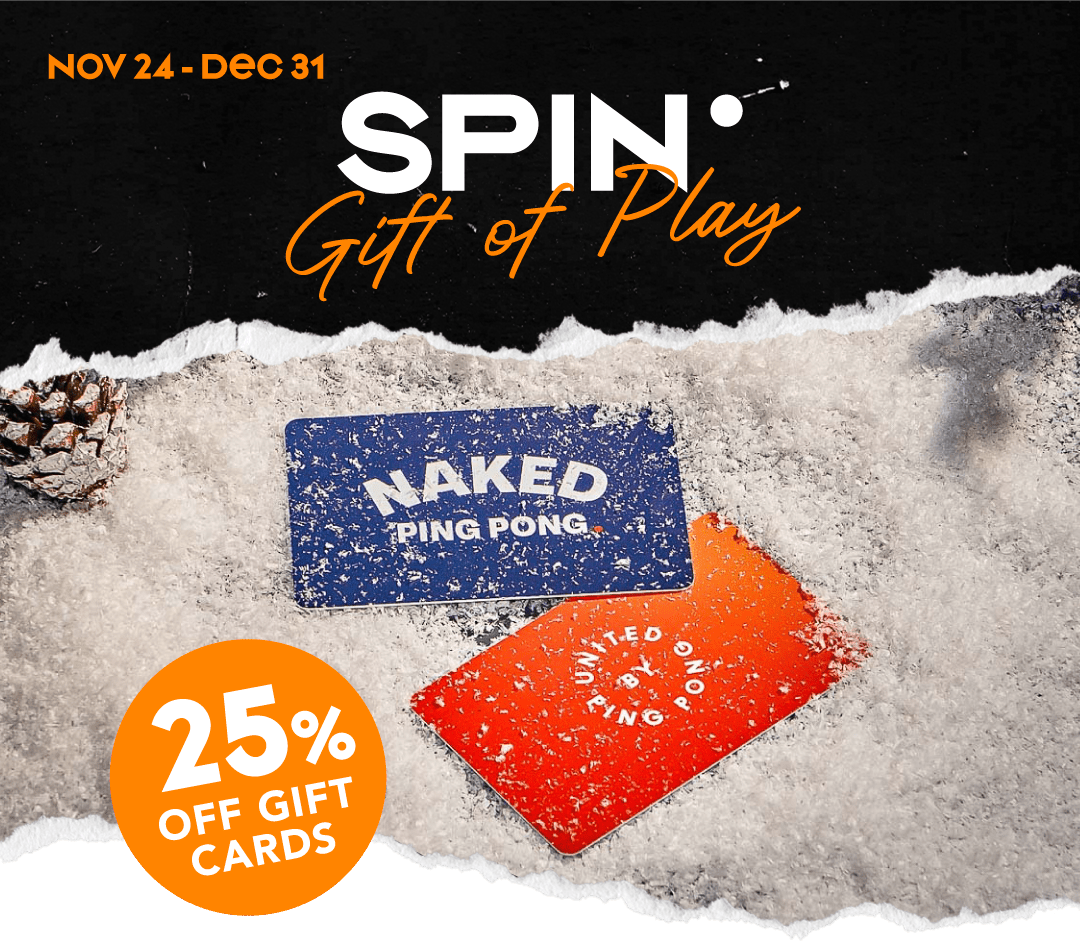
We built SPIN specifically around the kind of social, activity-driven experience that makes corporate holiday events genuinely memorable. Our venues across New York, Chicago, San Francisco, Toronto, Philadelphia, Seattle, and Boston are designed to solve the most common challenges event planners face:
- Olympic-grade ping pong tables with premium Stiga equipment provide built-in, accessible entertainment for all skill levels
- Two full-service bars and a chef-driven menu with shareable, social food keep guests fed and energized without interrupting the flow of the event
- Rotating DJs maintain the atmosphere throughout the evening
- Dedicated on-site event planners handle logistics so you do not have to coordinate multiple vendors
- Private event spaces accommodate groups of all sizes, from intimate team gatherings to large company-wide celebrations
- Customizable packages make it straightforward to match your budget and event goals
Whether you are planning a team-building evening or a full employee appreciation celebration, we handle the details so your team can focus on enjoying the night. Plan your corporate holiday event with us and give your team something to look forward to this year.